
rothe erde® slewing bearings - empowering a sustainable future
Rothe Erde: The technology and quality leader for slewing bearings with a unique global production and sales network!
Welcome to WindEnergy Hamburg 2026!
Moin Moin! We look forward to welcoming you at WindEnergy Hamburg 2026 from September 22nd to 25th .
Visit us in person at at the largest and most important meeting of the onshore and offshore wind industry in hall B6 at our booth 242.
Pay us a visit in Hamburg to get an impression of our innovations and solutions. Allow our experts on site to comprehensively inform and help you realize your projects. We are looking forward to exchanging with you!
Our product highlights at the fair - key components for the global energy transition
TRB-TRBs are particularly suitable for the use in offshore wind turbines. They have the following characteristics:
high service life
high system stiffness
low friction
A TRB-TRB arrangement is an adjusted bearing arrangement consisting of two single tapered roller bearings (TRB). Each of the two bearings consists of:
an inner ring
an outer ring,
a set of rolling elements and
a cage.
In conjunction with the shaft and housing, the two bearings form a preloaded bearing unit that enables the transmission of high moments with a simultaneously small bearing size. The tapered rolling elements allow a pure rolling contact between rollers and raceways. The correct adjustment of the system preload on the one hand ensures a sufficient load zone in the bearing and on the other hand ensures a high system stiffness. The different and individual contact angles of the two bearings allow an optimized distribution of the external loads as well as the absorption of high radial and axial forces.
The bearing rings are induction hardened by default using a process patented by thyssenkrupp rothe erde. We also offer bainitic or case-carburized variants. Production is possible at many international thyssenkrupp rothe erde locations.
TRB-TRB arrangements have a high span width and are therefore particularly suitable for supporting high moments. Compared to a single main bearing, the size of the individual bearing rows can be significantly reduced, making the TRB-TRB arrangement a cost-efficient alternative.
Particularly advantageous: As the bearing set is clamped, it can be mounted easily and safely.
TRB’s are tailor-made by thyssenkrupp rothe erde. We always take into account that on- and offshore wind turbines have different requirements. Characteristics of the specific turbine are already considered in the early design phase, while also a support in the design of the assembly process can be provided.
A long service life and a high resistance to common damage mechanisms are achieved through the design, material selection and hardening process.
We build on many years of experience in the field of main bearings. The continuous development of our products and technologies is ensured by one of the largest research facilities for slewing and large-diameter bearings, featuring our own test fields, in-house calculation and simulation tools, and close cooperation with national and international research institutes. In particular, we are able to validate TRB-TRB main bearing systems both on universal test rigs and in original customer-specific configurations, enabling realistic testing and verification under application-relevant operating conditions.
The power rating of wind turbines are more and more increasing - and so do the hub and tower heights as well as the rotor diameters. The size of the individual components connected to the pitch or yaw bearing, such as the hub and the blade, are growing in consequence of this size trend.
At the same time, the operating conditions of the pitch bearings are getting purposefully optimized on a turbine- and customer-specific basis to maximize power yield and to reduce dynamic structural loads. For pitch bearings that are used for a targeted, continuous adjustment of the pitch angle, this leads to an increase in pitch travel. Both development trends pose increasing technical challenges towards an efficient and reliable operation of pitch bearings of future multi-MW wind turbines in the on- and offshore sector.
In order to optimize the hubside system stiffness, particularly for large multi-MW and thus potentially low-stiffness hub structures, thyssenkrupp rothe erde has developed the Pitch Bearing Unit (PBU) for the requirements of next-generation pitch bearings.
The Pitch Bearing Unit is an extender bearing unit to be bolted between the hub and the blade. Both the integration of the pitch bearing functionality (ball or roller bearing) and that of the pitch drive (electric or hydraulic) are enabled based on this compact unit.
The optimized system stiffness offers significant mechanical advantages for the operation of the pitch bearing. At the same time, the integration of the pitch drive facilitates a targeted modularization of the complete pitch unit as well as a standardization of the hub across different product families, while at the same time simplifying the hub design in terms of the sourcing, machining and shipping processes.
Together with HAWE Energy Solutions and ITH bolting solutions, a hydraulic pitch drive has been developed for a 10MW offshore project and integrated into the PBU, as shown schematically in the following figure.
Learn more about these and other possible applications of the Pitch Bearing Unit also in the onshore area, e.g. for the targeted reduction of the hub size to solve hubside supply chain and / or transport restrictions as well as for the increase of the blade root diameter. Discuss with our team the advantages of the plug-and-play feature of the Pitch Bearing Unit and your requirements for a simplified component management, cost-optimized manufacturing and assembly processes.
Features
Integration of pitch bearing functionality
Integration of hydraulic or electrical pitching system
Plug-and-play feature
Structural design of PBU tailored to OEM-specific turbine design
Advantages
Superior blade bearing performance - derisiking strategy for 3RR bearing applications
Enabler for modularization and standardization of pitch system
Improved transportation (less hub size, in particular onshore)
Bigger blade root diameter feasible for given hub dimension
Less complex hub design and less hub machining costs
Easy OEM supply chain due to plug-and-play
Easy installation on site due to plug-and-play
Proven technology from a leading bearing manufacturer and pitch drive supplier
The Tower Ready Module is a fully preassembled, ready-to-mount pitch bearing replacement solution that helps wind farm operators keep older turbines running efficiently, reliably, and cost-effectively:
Complete plug-and-play module with all required components
Especially useful for older or discontinued turbine models where spare parts are difficult to source.
Reduced turbine downtime, logistics effort, and overall replacement costs.
Supports retrofits, upgrades, and sustainable refurbishment options
A Tower Ready Module is a fully preassembled spare-part solution for wind turbines, designed for the efficient replacement of pitch bearings. It is delivered ready for installation and includes the required components from a single source, such as an upgraded or refurbished pitch/slewing bearing, fasteners, spacer tubes, stiffening plates, lubrication components, grease discharge system, and pitch-lock system including sensor.
In short: it is a ready-to-mount “plug-and-play” module that helps operators replace critical pitch bearing components quickly and efficiently.
It makes sense to use a Tower Ready Module when wind farm operators need to keep older or discontinued wind turbine models running reliably, especially when original spare parts are difficult to source.
Typical use cases include:
replacing urgently needed pitch bearings in older turbines
retrofitting turbines that are operating beyond their intended design life
upgrading existing turbine components
replacing a full set of pitch bearing-related components
reducing complexity when several parts need to be sourced, coordinated, and installed
minimizing downtime during maintenance or replacement work
The main advantages are:
Reduced turbine downtime thanks to faster, more efficient installation
Lower logistics and delivery costs because required components come from one source
Greater manufacturer independence, especially for discontinued turbine models
Fast and hassle-free replacement through a preassembled, ready-to-mount solution
Cost-effective retrofit, upgrade, or full-set replacement options
Reliable compatibility and performance tailored to the specific turbine
In-house engineering and installation support from Rothe Erde
Sustainability benefits, as dismounted bearings can be inspected, potentially refurbished, and stored as spare bearings
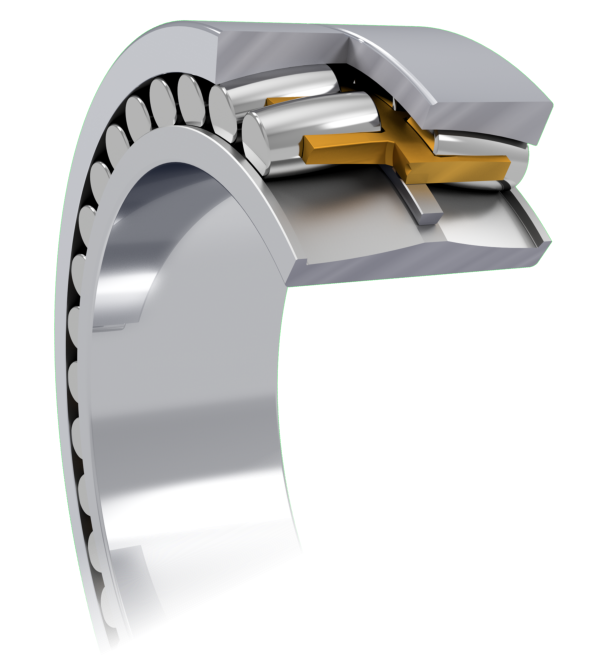
A spherical roller bearing is a robust, self-aligning bearing solution for applications with high loads and possible shaft misalignment. It is especially suitable for wind turbine main shafts, where reliability, durability, and operational safety are critical.
Carries high radial loads under demanding operating conditions
Compensates shaft deflection and misalignment
Supports long-term reliable operation in onshore and offshore wind turbines
A spherical roller bearing is a rolling bearing designed with two rows of rollers that can carry high radial loads while compensating for shaft misalignment.
It makes sense to use a spherical roller bearing when an application involves high radial loads, dynamic operating conditions, and possible shaft deflection or misalignment. This is especially relevant in wind turbines, where misalignment can be caused by structural deformation, wind loads, and installation tolerances.
The main advantages are its high load carrying capacity, self-aligning design, and robust performance under demanding conditions.
Wind energy plant expertise - from top to buttom
Along with innovative solutions for pitch bearings, yaw bearings and bearings for wind gearboxes, the main focus lies on developing main bearings. Rothe Erde has been crcially involved in its role as the global market leader for slewing bearings.
Intensive research and development has resulted in the successful deployment of Rothe Erde products in wind energy plants (both onshore and offshore) throughout the world. In order to test our products as realistically as possible, they are subjected to various tests on the rotor bearing and pitch bearing test benches in our 10,700 m² research and development center. Additionally, we investigate and improve the reliability and structural behavior of our products on site. With more than 60 years of experience in research, we are able to solve the biggest challenges in the development of slewing bearings for the wind industry.
With the aim of achieving advances in providing environmentally friendly energy, we are installing increasingly efficient wind energy plants around the world, which are now able to compete against fossil energy resources.
We at Rothe Erde are a strong, progressive partner in the field of onshore and off-shore systems. Our constant search for innovative breakthroughs enables our customers not just to be part of the new energy era but to advance it, and to make crucial contribution to securing a more environmentally friendly future. Together we master every challenge!
We are the reliable partner at your side
Global strength – local presence
You can find us where we are needed
- Production plants in 10 countries
- Global distribution network
- Local and decentralized sales
Full Service
A strong partner from A to Z
- Full implementation
- Extensive consulting & training
- Full after-sales services
Highest quality standards
We meet your requirements
- Modern calculation methods
- World's largest R&D center
- Complaint rate below 1%
The future of steel is green - thyssenkrupp will be completely climate neutral by 2045
Sustainability is a core element of our company strategy: As part of a global industrial group, Rothe Erde develops innovative product solutions, which not only secure long-term successes for our customers, but also make a positive contribution to global development.
We are convinced that we can substantially advance the CO2 neutrality of the industry with our engineering expertise. We achieve this not only by developing and manufacturing products that enable, for example, the sustainable transformation of energy generation and decarbonization, but also in our production processes. Resources are reused and recycled, processes become more energy efficient and, wherever possible, we use electricity from renewable sources. This project has already been implemented in Germany and France, and other plants will follow successively. We also, where it makes sense, install more and more photovoltaic systems at our plants, most recently for example on a newly built production hall in Lippstadt.
A Rothe Erde energy management system, certified to ISO 50001, has already been implemented at the major plants, the smaller plants will follow soon. We develop products, which by virtue of their shape and nature, already reduce resource consumption in production. thyssenkrupp is actively participating in the climate targets of the Paris Agreement and has set itself the goal of being completely climate neutral worldwide by 2045.
Sustainable manufacturing and procurement
Sustainable manufacturing and procurement

We use raw materials with a high percentage of recycled content to manufacture our products in a way that conserves resources as much as possible. We also rely on recyclable materials in production.
In addition to our product design and manufacturing technology, which enables the energy-saving production, we reduce our CO2 emissions by shortening our transportation routes. This includes:
the local procurement of raw materials,
our own production of components, and
local production.
All our plants are certified to OHSAS 18001 and ISO 14001 standards and follow the ISO 50001 energy management system. The plants with high energy relevance are certified to standard ISO 50001.
Sustainability also plays an equally important role in our supplier management at thyssenkrupp rothe erde. We are continuously developing our processes. In this way, we aim to increase transparency on the origin of raw materials and conflict minerals in order to identify risks at an early stage.